



IUI or IVF: How Does a Fertility Specialist Decide Which Treatment May Be Right for You?

When couples first explore fertility treatment, two terms may appear in mind : IUI or IVF. Because IVF is more widely recognised, it can be easy to assume that every fertility journey eventually leads there. In reality, the decision is more individual.
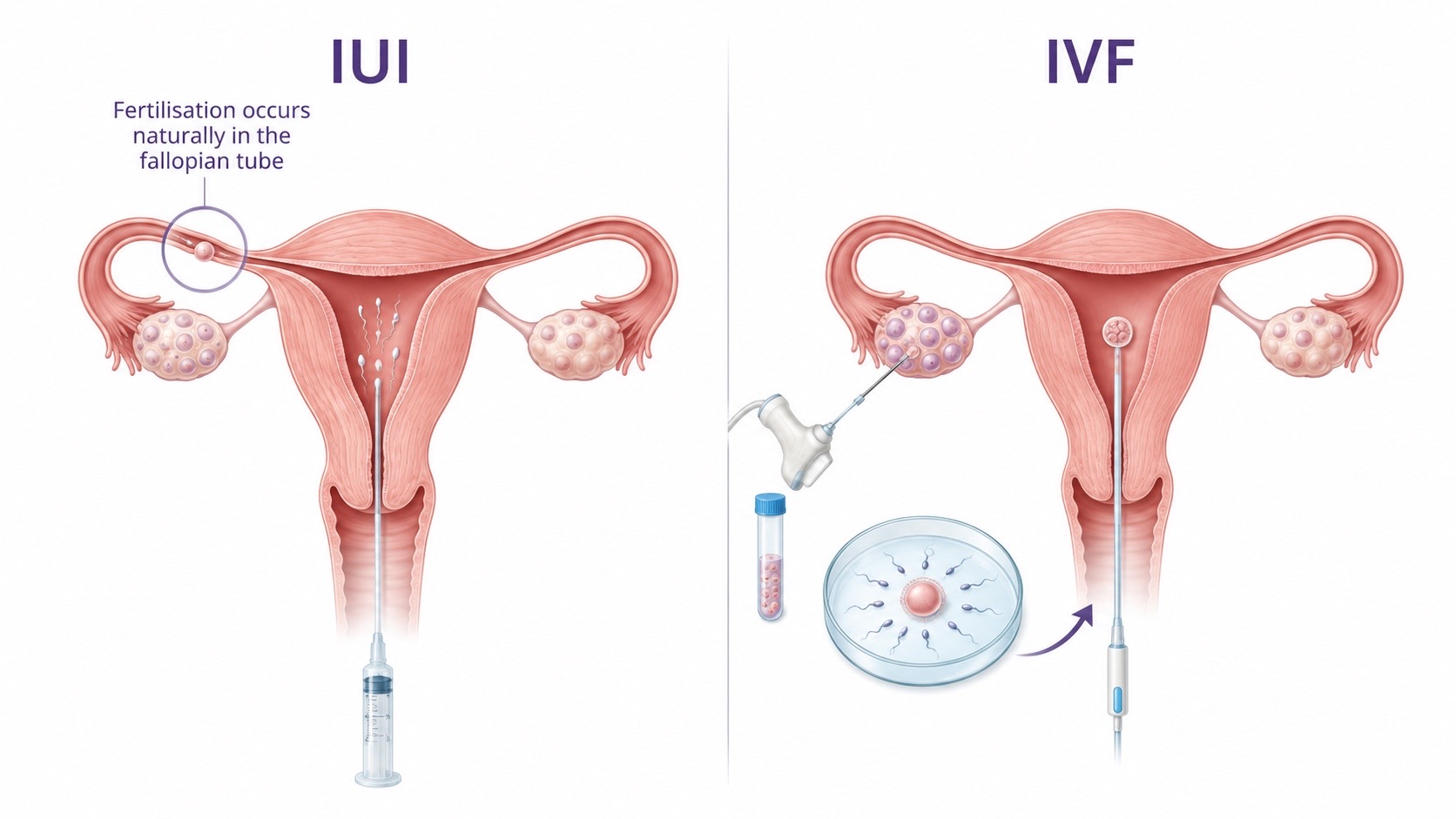
Some couples may be suitable for intrauterine insemination (IUI), a simpler treatment that places prepared sperm directly into the uterus around ovulation. Others may benefit from in vitro fertilisation (IVF), where eggs are collected and fertilised in a laboratory before an embryo is transferred to the uterus.
At Sunway Fertility Centre, both IUI and IVF are available as part of a broader range of fertility services. Let’s understand more with Dr Ashley Chung Soo Bee, Consultant Obstetrician, Gynaecologist and Fertility Specialist, on how fertility specialists decide which treatment may fit a couple’s situation.
What is IUI?
Intrauterine insemination is a fertility treatment in which sperm is prepared and concentrated, then placed directly inside the uterus close to the time of ovulation. Fertilisation still needs to happen naturally inside the fallopian tube.
Because IUI depends on the sperm and egg meeting inside the body, at least one functioning fallopian tube is generally needed. Ovulation, sperm quality and timing also matter.
What is IVF?
In vitro fertilisation involves stimulating the ovaries to retrieve multiple mature eggs, fertilising them with sperm in the laboratory, nurturing and growing the embryos in embryos cope and then transferring an embryo into the uterus.
Because fertilisation happens outside the body, IVF can bypass certain problems that make natural fertilisation difficult, such as significant tubal disease. Intracytoplasmic sperm injection (ICSI), where one sperm is injected directly into an egg, may be used in selected cases to overcome male factor subfertility.
SMCV's Fertility Medicine service includes IUI, IVF, ICSI, embryo transfer, frozen embryo transfer, fertility preservation and other assisted reproductive techniques.
When might IUI be considered?
- Unexplained infertility in selected couples.
- Mild male-factor fertility issues when enough usable sperm are available after preparation.
- Ovulation problems that are being treated with ovulation-induction medication.
- Certain cervical factors that make it harder for sperm to pass naturally.
- Situations where a less invasive first-line treatment is appropriate after assessment.
- Female gynaecological tract condition such as vaginismus.
IUI is not an absolute treatment which is suitable for every diagnosis. An initial assessment needs to assess each patient to cater a personalized treatment for them .Significant blockage of both fallopian tubes, severe sperm abnormalities or some age-related fertility situations may make another approach for IVF instead.
When might IVF be recommended earlier?
- Both fallopian tubes are blocked or severely damaged.
- There is significant male-factor infertility that may require ICSI.
- There is reduced ovarian reserve or age-related decline where time is an important consideration.
- Other fertility treatments have not resulted in pregnancy.
- There is significant endometriosis / adenomyosis or other reproductive condition affecting fertility.
- Preimplantation genetic testing is being considered for an appropriate medical indication, for example : thalassemia carrier couples
The decision is not based on a single test. Fertility specialists usually combine the medical history, age, duration of infertility, ovarian reserve, tubal assessment, semen analysis and previous treatment history.
Is IUI always tried before IVF?
No. Some couples may start with IUI, while others may be advised to consider IVF earlier because of their diagnosis or reproductive timeline. For example, trying several IUI cycles may not be the most efficient option when both fallopian tubes are blocked.
The aim is not to follow the same sequence for every couple, but to choose a treatment strategy that matches the underlying fertility factors.
How do age and ovarian reserve affect the decision?
Female age is an important fertility factor because both egg quantity and egg quality change over time. Ovarian reserve tests can provide information about the expected response to stimulation, but they do not provide a simple yes-or-no answer about whether natural pregnancy is possible.
When age or ovarian reserve suggests that time may be more limited, a fertility specialist may discuss whether moving more directly to IVF is reasonable rather than spending many months on lower-intensity treatment.
How does sperm quality influence IUI versus IVF?
Semen analysis looks at factors such as sperm concentration, movement and appearance. Mild abnormalities may still be compatible with IUI in selected cases. More significant male-factor infertility may reduce the likelihood that enough sperm will reach and fertilise the egg naturally.
In IVF, ICSI may be considered when there are significant sperm concerns, because a single sperm can be injected directly into an egg in the laboratory.
What about unexplained infertility?
Sometimes fertility testing does not identify one clear reason why pregnancy has not occurred. This is called unexplained infertility. In these situations, age, duration of infertility and previous attempts may help guide whether treatment begins with ovulation induction and IUI or progresses to IVF.
What should couples ask before deciding?
- What do our test results suggest is the main fertility issue?
- Are my fallopian tubes open and healthy enough for IUI?
- How does my age or ovarian reserve affect our timeline?
- Is there a male-factor issue that may influence treatment choice?
- How many IUI attempts would be reasonable before reassessing the plan?
- What are the medication, monitoring and procedure steps for each option?
The right fertility treatment starts with the right diagnosis
Choosing between IUI and IVF is not simply a matter of selecting the easier or more advanced treatment. Each approach solves a different set of fertility challenges.
A complete assessment of both partners helps the fertility team recommend a pathway that is medically appropriate, realistic and aligned with the couple’s priorities.
For personalised fertility assessment and assisted reproductive treatment in Kuala Lumpur, learn more about the Sunway Fertility Centre, explore Fertility Medicine services or view the profile of Dr Ashley Chung Soo Bee.
Frequently Asked Questions
Was this article helpful?
0 out of 0 found this helpful
Suggest to Read