


Dense Breasts: What Do They Mean for Your Mammogram?

You have had your mammogram, and your report mentions “dense breasts” or “dense breast tissue.”
What does that actually mean? Should you be worried? Does it affect how well your mammogram can detect breast cancer? And do you need another type of screening?
This Pink October, join our Consultant General Surgeon, Breast & Endocrine Surgeon, Dr. Suziah Mokhtar, as we explore why breast density matters, how it may affect your mammogram results, and what you should discuss with your doctor.

What Does It Mean to Have Dense Breasts?
Breast density describes how your breast tissue looks on a mammogram.
Breasts are made up of fatty tissue as well as fibrous and glandular tissue, including the milk glands and milk ducts. When there is more fibrous and glandular tissue compared with fatty tissue, the breasts are described as dense.
Dense breasts are common. They are not a disease and do not mean that something is wrong.
You also cannot tell whether you have dense breasts by their size, firmness or how they feel. Breast density can only be assessed on a mammogram.
Why Should You Know Your Breast Density?
Knowing your breast density is useful for two main reasons.
First, dense breast tissue can make some cancers more difficult to see on a mammogram.
Fatty breast tissue appears darker on a mammogram, while dense breast tissue appears white. Some breast cancers can also appear white, which means an abnormality may be harder to distinguish when it is surrounded by dense tissue.
Think of it as trying to find a white object against a white background.
Second, having dense breasts is associated with a higher risk of developing breast cancer compared with having less dense breast tissue.
However, breast density is only one part of your overall breast cancer risk. Your age, family history, genetic factors, previous breast conditions and other aspects of your health may also influence your risk.
Having dense breasts does not mean that you have breast cancer.
How Is Breast Density Classified?
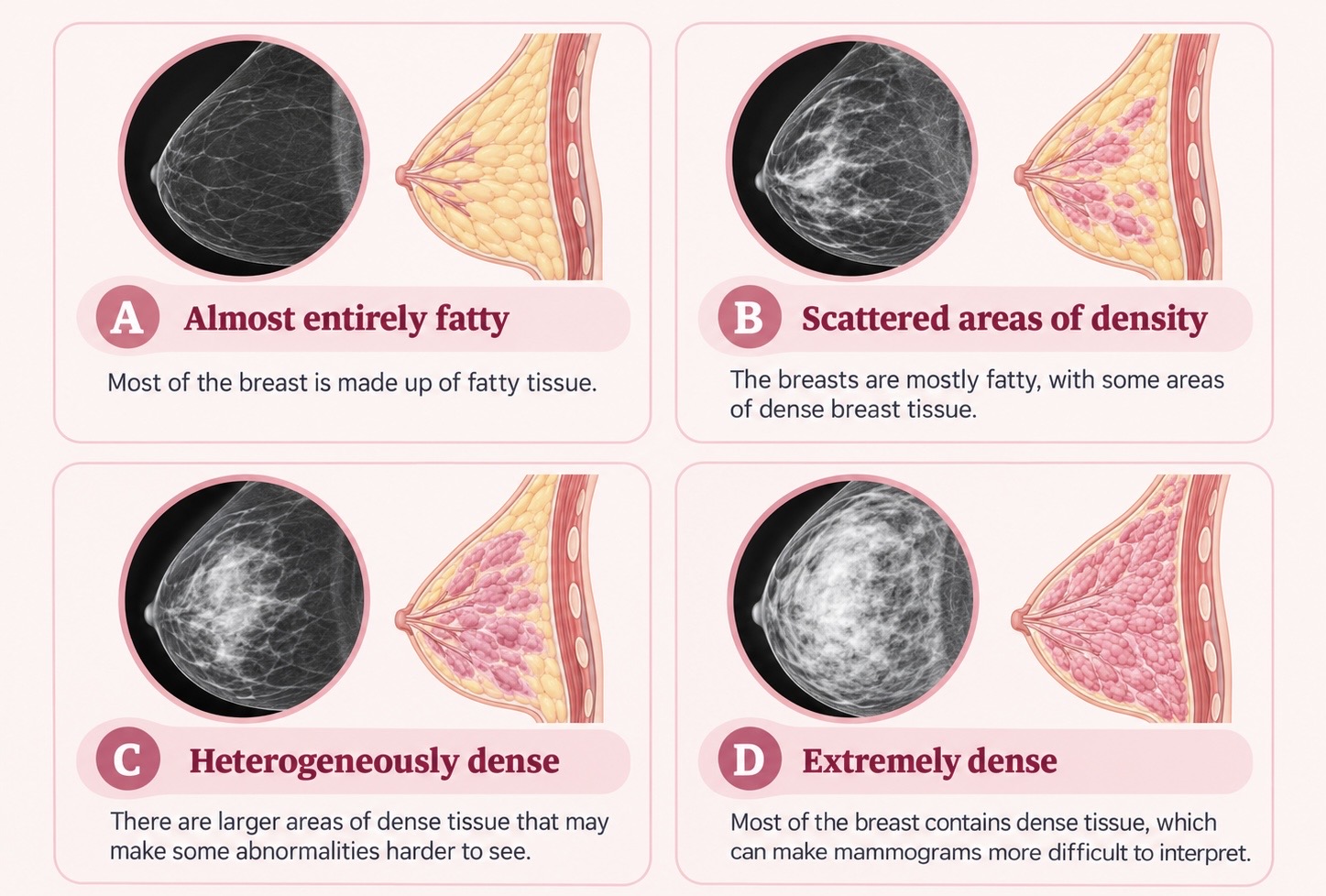
Radiologists commonly use four categories to describe breast density:
Category A: Almost entirely fatty
Most of the breast is made up of fatty tissue.
Category B: Scattered areas of density
The breasts are mostly fatty, with some areas of dense breast tissue.
Category C: Heterogeneously dense
There are larger areas of dense tissue that may make some abnormalities harder to see.
Category D: Extremely dense
Most of the breast contains dense tissue, which can make mammograms more difficult to interpret.
Categories C and D are generally considered dense breasts.
If you are unsure which category you fall into, check your mammogram report or ask your doctor.
Why Are Some Breasts Denser Than Others?
There is no single reason why one woman has denser breasts than another.
Breast density can be influenced by factors such as age, genetics, body composition and hormones.
Breasts often become less dense as women get older, although this does not happen to everyone. Hormonal treatments, including some forms of menopausal hormone therapy, may also affect breast density.
If I Have Dense Breasts, Is a Mammogram Still Useful?
Yes.
Dense breasts do not mean that mammography is ineffective or that you should stop having mammograms.
Mammography remains an important breast cancer screening tool, including for women with dense breasts.
Newer imaging technologies, such as 3D mammography or breast tomosynthesis, can provide radiologists with more detailed views of the breast from different angles and may help them assess overlapping breast tissue.
The type of mammogram or screening method suitable for you will depend on your individual circumstances and your doctor’s recommendation.
Do Dense Breasts Mean I Need an Ultrasound or MRI?
Not necessarily.
Some women with dense breasts may benefit from additional imaging, particularly when breast density is combined with other breast cancer risk factors.
Depending on your individual situation, your doctor may discuss tests such as breast ultrasound or breast MRI.
However, additional imaging also has limitations. It can sometimes detect findings that require more tests but later turn out not to be cancer. This is known as a false-positive result and may lead to extra scans or biopsies.
This is why having dense breasts does not automatically mean that you need more tests.
The decision should be based on your overall breast cancer risk, mammogram findings and personal medical history.
So, What Should I Do If My Mammogram Says I Have Dense Breasts?
First, do not panic.
Dense breast tissue is common and does not mean that breast cancer has been found.
Instead, use the information to better understand your own breast health.
You can ask your doctor:
What is my breast density category?
Knowing whether your breasts fall into Category A, B, C or D can help you understand your mammogram report.
Did my mammogram show anything else?
Breast density and the actual mammogram findings are different pieces of information.
What is my overall breast cancer risk?
Your doctor can assess breast density together with your age, family history and other risk factors.
Do I need additional imaging?
For some women, further imaging may be useful. For others, continuing with the recommended mammography schedule may be appropriate.
What If My Mammogram Is Normal but I Notice a Breast Change?
Do not ignore a new breast change simply because your mammogram was normal.
Speak with your doctor if you notice a new lump, nipple discharge, changes to the nipple or breast skin, or any persistent change that is unusual for you.
Breast screening and being aware of changes in your own breasts work together. One does not replace the other.
What Should You Remember About Dense Breasts?
Dense breasts are common and are not the same as breast cancer.
What makes breast density important is that it can make some cancers more difficult to see on a mammogram and is also one factor associated with breast cancer risk.
The aim is not to worry about whether your breasts are dense.
It is to understand what your breast density means for you and whether it changes anything about the way your breast health should be monitored.
This Pink October, Know More Than Your Mammogram Result
Getting a mammogram is an important step.
Understanding what your mammogram says is the next one.
If your report mentions dense breast tissue, speak with your doctor about your breast density, your individual risk factors and whether your current breast screening plan is suitable for you.
Know your breast density. Understand your risk. Make informed decisions about your breast health.
Learn More About Breast Screening Book an Appointment
Was this article helpful?
1 out of 1 found this helpful
Suggest to Read