



Blocked Fallopian Tubes and Fertility: Can You Still Get Pregnant?

When a couple has been trying to conceive for months, it is natural to focus on whether ovulation is happening. For some women, regular periods can feel reassuring because the cycle appears predictable. But fertility depends on more than ovulation alone.
The fallopian tubes play a key role in natural conception. They provide the pathway where sperm and egg usually meet, and they help transport the early embryo toward the uterus. If one or both tubes are blocked or damaged, pregnancy may become more difficult even when menstrual cycles are regular.
At Sunway Medical Centre Velocity (SMCV), fertility assessment and treatment are available through the Sunway Fertility Centre. Let’s understand more with Dr Samantha Tee Mei Li, Consultant Obstetrician, Gynaecologist and Fertility Specialist, on why tubal health matters and how fertility specialists investigate possible blockages.
What do the fallopian tubes do in conception?
The fallopian tubes connect the area near the ovaries to the uterus. After ovulation, the egg enters a fallopian tube. Sperm travel through the cervix and uterus toward the tube, where fertilisation commonly occurs. The fertilised egg then travels toward the uterus for implantation.
A blockage can interrupt this process. If both tubes are fully blocked, sperm cannot reach the egg through the usual pathway. If one tube is healthy, natural pregnancy may still be possible, depending on other fertility factors.
What can cause a fallopian tube to become blocked or damaged?
- Previous pelvic inflammatory disease or infection.
- Scar tissue or adhesions after pelvic or abdominal surgery.
- Previous ectopic pregnancy.
- Endometriosis that affects the tubes or surrounding pelvic anatomy.
- Hydrosalpinx, where a damaged tube becomes swollen and filled with fluid.
- Less commonly, congenital or structural abnormalities of the reproductive tract.
Some women have no obvious symptoms. Others may have a history of pelvic pain, painful periods, previous infection, ectopic pregnancy or surgery. This is one reason tubal problems can remain unnoticed until fertility is investigated.
Can blocked fallopian tubes cause symptoms?
Often, there are no specific symptoms. A woman may have regular periods, normal hormonal tests and no significant pelvic discomfort. Tubal factor infertility may only become apparent when pregnancy does not occur as expected.
Hydrosalpinx can sometimes be associated with pelvic discomfort or unusual discharge, but symptoms are not reliable enough to confirm or exclude a blockage.
How are fallopian tubes checked during fertility assessment?
A fertility specialist first reviews both partners, because infertility can involve female factors, male factors, a combination of both, or remain unexplained after standard testing.
For the tubes, one commonly used test is hysterosalpingography, often called an HSG. During an HSG, contrast material is introduced through the cervix while X-ray imaging shows the shape of the uterine cavity and whether the contrast passes through the fallopian tubes.
An HSG can help identify a possible blockage, but the result needs to be interpreted in the context of the full fertility assessment. Sometimes a tube can appear blocked because of temporary spasm, and additional evaluation may be advised.
What happens if one fallopian tube is blocked?
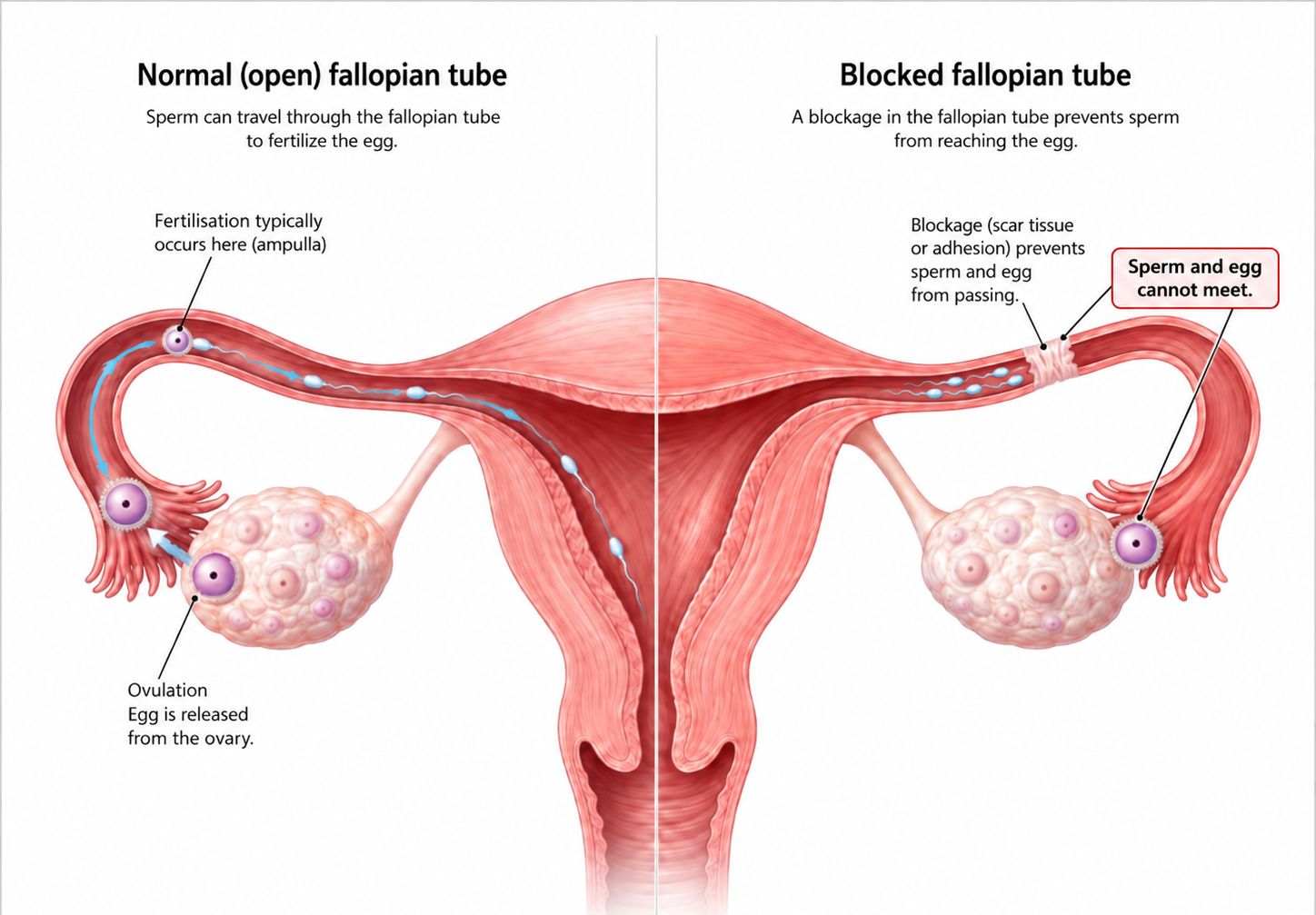
Pregnancy may still be possible if the other tube is healthy, ovulation is occurring and there are no major additional fertility concerns. Age, ovarian reserve, sperm quality and how long a couple has been trying to conceive also influence the overall plan.
Rather than focusing on the tube result alone, fertility care usually considers the couple’s complete fertility picture.
What if both fallopian tubes are blocked?
If both tubes are significantly blocked, natural fertilisation becomes difficult because sperm and egg cannot meet through the usual route. In vitro fertilisation (IVF) may be considered because fertilisation takes place in the laboratory before an embryo is transferred into the uterus, effectively bypassing the fallopian tubes.
SMCV's Fertility Medicine service includes fertility assessment, intrauterine insemination and IVF services, as well as laparoscopic and hysteroscopic procedures where clinically appropriate.
Does every blocked tube need surgery?
No. Depends on where the blockage is, whether unilateral/ bilateral, whether there is fluid in the tubes (hydrosalpinx). Hydrosalpinx may require surgical management before embryo transfer
When should a couple consider fertility assessment?
Many guidelines suggest seeking fertility evaluation after 12 months of regular unprotected intercourse when the woman is under 35, or after 6 months when she is 35 or older. Earlier assessment may be appropriate when there is a known reproductive condition, irregular cycles, previous pelvic infection, endometriosis, ectopic pregnancy, pelvic surgery or a known male-factor concern.
For couples who would like a structured starting point, SMCV also offers a Couple Fertility Screening Package designed to assess reproductive health in both partners.
A normal period is only one part of the fertility picture
Regular cycles are useful information, but they cannot confirm that every step needed for conception is working normally. When pregnancy is taking longer than expected, evaluating the fallopian tubes can help identify whether there is a physical barrier between ovulation and fertilisation.
To learn more about fertility assessment, HSG testing pathways and treatment options, visit the Sunway Fertility Centre at Sunway Medical Centre Velocity, Kuala Lumpur or learn more about Dr Samantha Tee Mei Li.
Frequently Asked Questions
Was this article helpful?
0 out of 0 found this helpful
Suggest to Read