



.jpg)
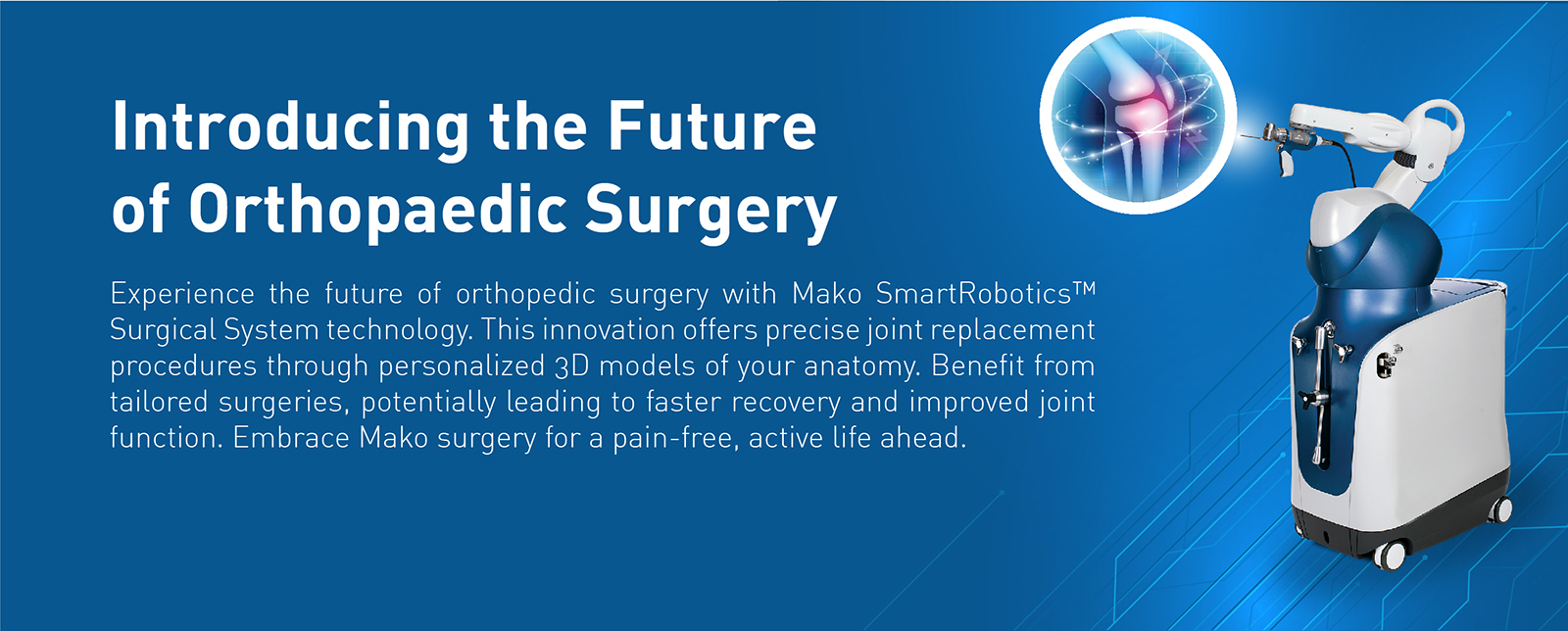
Benefits of Mako SmartRobotics Surgical System

Precision and Customisation
Mako SmartRobotics™ Surgical System uses 3D imaging (CT scan) to create a customised patient-specific surgical plan.

Less Invasive Surgery
Mako SmartRobotics™ Surgical System assisted procedures require smaller incisions compared to traditional surgery.

Lesser Pain and Faster Healing
Less invasive approach with smaller incisions and precise bone cuts, combined with Mako SmartRobotics™ Surgical System, results in reduced pain, faster recovery, and increased patient satisfaction.

Lower Risk of Implant Failure
Accurate implant positioning reduces friction, wear, lower risk of complicatons and need for future revision surgery.
How the Mako SmartRobotics Surgical System Works
An innovative robotic platform utilised in orthopaedic surgeries, particularly for procedures like knee and hip replacements.
Types of Surgery

Total Hip Replacements
Surgery to replace damaged hip joint with an artificial one, easing pain and improving mobility.

Total Knee Replacements
Surgery to replace damaged knee joint with an artificial one, relieving pain and restoring mobility.

Partial Knee Replacements
Surgery to replace only the damaged part of the knee joint, preserving healthy tissue and providing pain relief.
FAQ
Who can have Mako SmartRobotics™ Surgical System robotic arm assisted surgery?
Mako SmartRobotics™ Surgical System is typically recommended for individuals who require orthopedic procedures, particularly joint replacements such as knee or hip surgery. Candidates for this advanced technology often include patients suffering from conditions like osteoarthritis, rheumatoid arthritis, or other degenerative joint diseases that affect the hip or knee. Additionally, individuals who have experienced joint damage due to injury or trauma may also benefit from Mako SmartRobotics™ Surgical System.
Are there any risks associated with Mako SmartRobotics™ Surgical System robotic arm assisted hip and knee surgery?
All surgeries carry some level of risk, and your surgeon will explain these during your pre-surgical consultation. Clinical studies show that Mako technology can help reduce certain risks by improving the accuracy of implant positioning, lowering the chance of blood loss, and decreasing the likelihood of hip dislocation.
Does the robotic arm perform the surgery?
No. The robotic arm does not perform the surgery on its own. It is a precise tool that assists the surgeon throughout the procedure. The surgeon remains in full control at all times, guiding the robotic arm using real-time feedback.
For both knee and hip replacements, the surgeon uses the MAKO planning system and 3D scans to create a personalized surgical plan. The robotic system helps the surgeon execute this plan with high accuracy, while the surgeon’s experience and judgement ensure proper alignment, balance, and overall outcomes.
This combination of advanced technology and surgical expertise leads to improved precision and greater patient satisfaction.
For both knee and hip replacements, the surgeon uses the MAKO planning system and 3D scans to create a personalized surgical plan. The robotic system helps the surgeon execute this plan with high accuracy, while the surgeon’s experience and judgement ensure proper alignment, balance, and overall outcomes.
This combination of advanced technology and surgical expertise leads to improved precision and greater patient satisfaction.
What about the recovery time?
With the use of this technology, many patients find that they have a shorter recovery time. This can depend on other factors. However, most patients can be walking again within the first day or two and get back to their normal routine within six weeks. Typically, most patients will only spend one night or two in the hospital to ensure they are monitored closely in the initial hours after the operation. This is because the technology is more precise, tailored to the specific patient’s individual body, and is less invasive during the operation. Of course, care and attention still need to be taken to ensure a successful recovery.
Am I too old for a joint replacement?
Age alone is not the sole determining factor for whether someone is a candidate for joint replacement surgery. While older adults may face certain health considerations, such as decreased bone density or existing medical conditions, many individuals in their later years successfully undergo joint replacement procedures and experience significant improvements in their quality of life. The decision to proceed with joint replacement surgery is typically based on various factors, including the severity of joint pain, level of joint dysfunction, overall health status, and the individual's goals and expectations for surgery.. Further discussion with the doctor on multiple factors will determine whether joint replacement is right for you.